By Ilane Tall · Updated November 29, 2026 · Research-based.
Reader-supported: we may earn a commission when you buy through the links on this page, at no additional cost to you. It never changes which product we recommend. Prices quoted below were correct at the time of writing and move often — confirm the current price on Amazon before buying.
Quick answer
“Programmable” means a slow cooker counts down a time you set, then switches to Warm instead of continuing to simmer. The feature only pays off if the timer covers your day: a short or fixed timer can run out hours before you get home, while a long adjustable window, or Crock-Pot’s MyTime, is built for that gap.
For a straightforward 24-hour countdown with Low, High and Warm, the Chefman 7-Quart Programmable at $42.74 covers the widest range here. If your schedule shifts day to day, the Crock-Pot MyTime 7-Quart ($59.99) adjusts its cooking cycle to a dinner time you set, not just a countdown.
Not sure a clock is the feature you need? See when a manual dial is still enough, or jump to the picks.
What “programmable” actually means: a countdown, then Warm
Every slow cooker heats food the same way, with a heating element in the base warming a crock from the outside in. The difference a programmable model adds is not heat, it is memory. A manual cooker has a dial for Low, High and usually Warm, and stays at whatever setting you chose until a person turns the dial again. A programmable cooker adds a digital panel: key in how long you want it to cook, at Low or High, and a countdown begins. At zero, the cooker switches itself — usually to Auto-Warm or Keep Warm — and holds the food at serving temperature instead of letting it keep simmering.
That single behavior is the case for paying more. A pot roast recipe written for eight hours on Low does not quietly become an eleven-hour pot roast because traffic was bad. The Chefman Slow Cooker 7 Quart states a 24-Hour Timer alongside Low, High and Warm on its digital control: pick a heat level, pick a duration, and let the clock do the part a person would otherwise have to remember. The Crock-Pot Programmable 7-Quart (Cook & Carry) describes the same idea as programmable up to 20 hours, and our top overall pick on the homepage runs the identical logic.
What a programmable timer is not is a thermostat for the food itself: it tracks elapsed time, not the pot’s internal temperature, with no idea whether a roast is actually done, only that the clock has run out. That matters later, when the countdown has to match a workday that doesn’t run exactly eight hours.
Three kinds of clock: fixed presets, free timers and MyTime
“Programmable” on a listing covers more than one kind of control, and the six cookers here split cleanly into three approaches.
The first is a fixed set of preset durations rather than a free-running countdown. The Hamilton Beach Set & Forget 7 Quart is built this way: the listing states 3 heat settings and 5 time settings, so you pick from a short menu rather than dialing in an arbitrary number of hours. It is less flexible, but simpler to operate — no way to mis-key a number from a short list. The larger Hamilton Beach Set & Forget 8 Quart uses the same logic with what its listing calls adjustable time settings.
The second is a free-running countdown timer, where you set any duration up to the stated maximum. The Chefman’s 24-Hour Timer and the Crock-Pot Cook & Carry’s 20-hour maximum both work this way: dial in the hours you actually need, rather than choosing from a short menu. This matters most for the workday math below, since the timer’s ceiling is also the ceiling on how long you can safely be away.
The third is Crock-Pot’s MyTime, which inverts the question. Instead of how long you want the cooker to run, MyTime asks when you want to eat, and adjusts the cooking cycle to land on that time. The Crock-Pot Programmable 7-Quart with MyTime Technology does the backward planning for you — the most schedule-aware of the three, useful when you know your target dinner time but not your exact finish time.
Fixed presets
A short menu of durations instead of a dial-in clock. The Hamilton Beach models use this: 5 time settings on the 7-quart, adjustable settings on the 8-quart. Simple to operate, less flexible for an odd number of hours.
Free countdown & MyTime
The Chefman (24-hour) and Crock-Pot Cook & Carry (20-hour) let you dial in any duration up to the maximum. MyTime goes further and adjusts the cycle to a dinner time you set, not a duration you calculate.
One of the six, the bella SAVOR 6-Quart, is described only as programmable, with no stated timer range or preset count. We won’t guess at a number the maker doesn’t publish — check the current listing before buying if the timer window matters to your decision.
Timer range against a real workday and commute
A timer’s stated maximum only matters against how long you are actually away, almost always longer than the eight hours a recipe assumes. An 8-hour workday is rarely an 8-hour absence: add a commute each way and a stop at the store, and the gap between leaving and walking back in regularly runs ten or eleven hours, more on a bad traffic day.
01
Leave the house
Set a countdown at or above the time you expect to be gone, not the recipe’s stated cook time alone.
02
The workday itself
Eight hours at a desk is the easy part. The two commutes bracketing it push total absence past what a recipe assumes.
03
Errands on the way home
A grocery run adds 20–40 minutes a fixed, short timer has no way to account for.
04
Walking back in
The moment a programmable cooker earns its price: Warm holding the meal, instead of hours of unattended simmering.
Against that math, a timer’s ceiling matters more than its headline number suggests. The Chefman’s 24-hour timer and the Crock-Pot Cook & Carry’s 20-hour maximum both comfortably cover a long commute day. The Hamilton Beach 7-Quart’s 5 fixed time settings cover a standard day, but check the listing for the longest preset before an unusually long one. MyTime sidesteps the ceiling: since you set a target dinner time, a shifting schedule matters less.
The practical takeaway: match the timer to your longest typical day away, not your average one. A cooker bought for an eight-hour office day and used on an eleven-hour day with errands stacked on top is running past its intended window — the gap Warm mode exists to close.
Warm settings and the USDA’s 140°F line
Warm mode is not cosmetic; it is the half of the programmable equation that keeps food safe to eat whenever you get home. The USDA defines the food safety “danger zone” as 40–140°F, where bacteria multiply fastest, and its guidance is to hold cooked food at or above 140°F until served. A Warm setting is designed to sit above that line — the point of switching to it automatically rather than leaving a finished meal on a High or Low setting it no longer needs.
None of the six listings here publish the exact holding temperature their Warm setting reaches — a spec makers rarely print. Treat Warm as designed to hold food above the danger zone, per the USDA’s general guidance, rather than assuming a specific number for any model.
This is why switch-to-Warm behavior matters more than timer length alone. A cooker that counts down accurately but simply shuts off isn’t solving the same problem as one that holds at a safe serving temperature afterward. Every cooker here that states a Warm setting — the Chefman, both Hamilton Beach models, both Crock-Pot models — does the more useful thing. A listing that only promises a timer and says nothing about what happens next is worth questioning before you buy.
The picks
Six programmable slow cookers, chosen to cover the real differences in how their clocks work: a wide free-running countdown, fixed presets, backward-planning MyTime, and the entry-level end of the category.
The six, side by side
| Slow cooker | Best for | Capacity | Timer | Price | Get it |
|---|
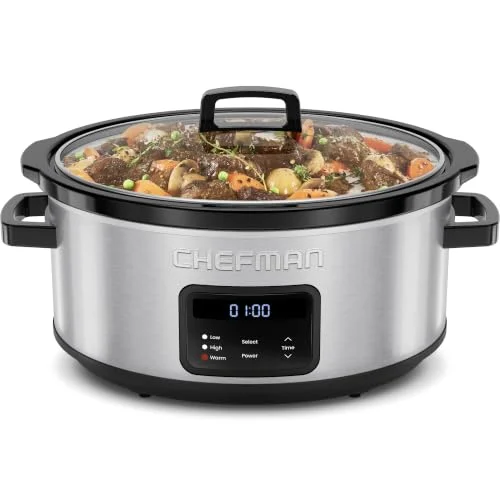 Chefman 7-Qt Programmable |
Widest free-running countdown |
7 qt |
24-hour timer |
$42.74 |
Get it |
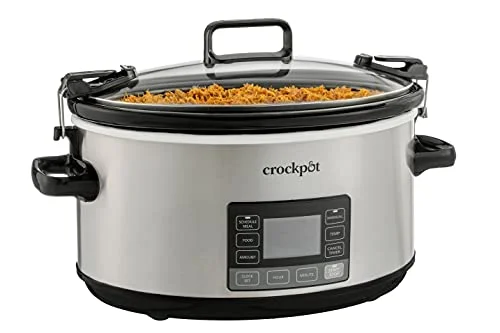 Crock-Pot 7-Qt MyTime |
A schedule that moves |
7 qt |
MyTime (target-time) |
$59.99 |
Get it |
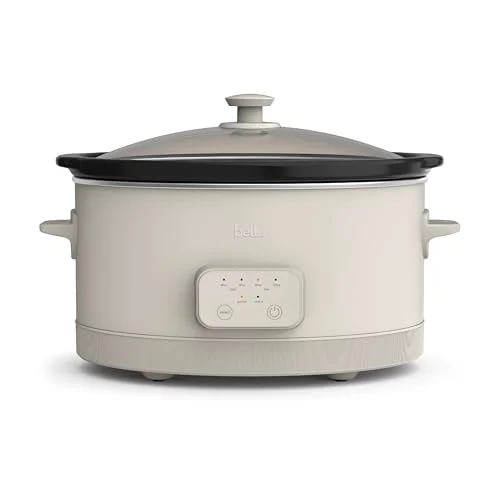 bella SAVOR 6-Qt |
Lowest-cost entry |
6 qt |
Programmable (range n/a) |
$29.99 |
Get it |
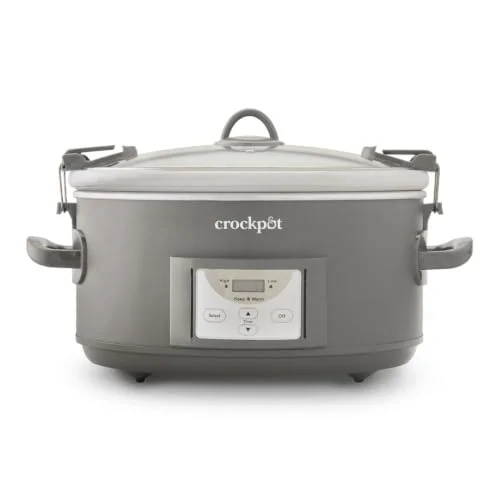 Crock-Pot 7-Qt Cook & Carry |
Travel days |
7 qt |
Up to 20 hours |
$68.00 |
Get it |
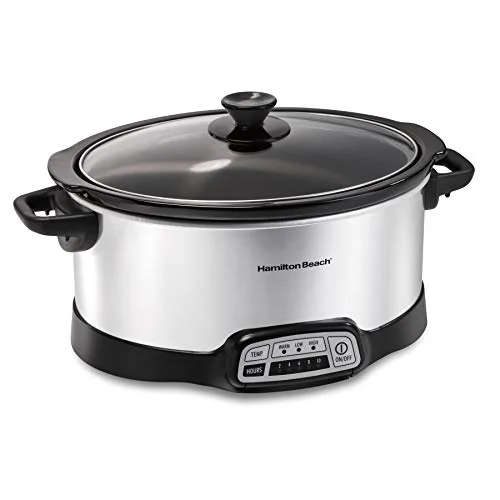 Hamilton Beach 7-Qt Set & Forget |
Simple fixed presets |
7 qt |
5 time settings |
$59.95 |
Get it |
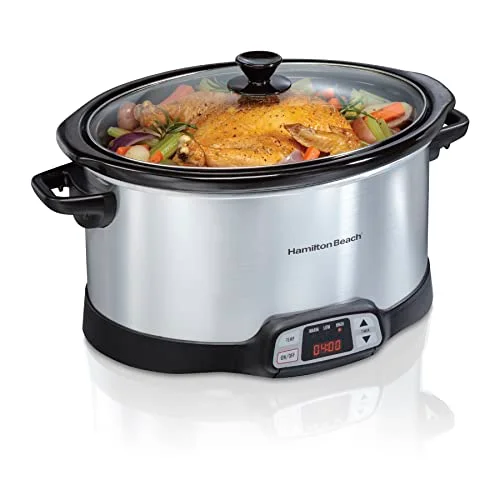 Hamilton Beach 8-Qt Set & Forget |
Bigger batches |
8 qt |
Adjustable time settings |
$79.95 |
Get it |
When a manual dial is still enough
A programmable timer solves one problem: being away from the cooker longer than you can predict, or longer than a recipe assumes. If that isn’t your situation, the feature is paying for a problem you don’t have. Someone home most of the day, able to flip a dial from High to Warm at roughly the right time, gets the same result a programmable cooker delivers automatically — our homepage comparison covers a manual-dial option alongside the programmable six here, for exactly that reason.
A manual dial is also the simpler machine: fewer electronics to fail, one obvious control instead of a menu to learn. It’s the better buy for a retired household, a work-from-home kitchen, or a weekend cook rarely out for a whole cooking cycle. Programmable earns its premium on the days nobody is home to watch the clock — if those days are rare, it buys less than it would for someone leaving the house ten hours, five days a week.
How we picked, and how we compared
We started from six current listings described as programmable, spanning 6 to 8 quarts and three approaches to the clock: free-running countdown, fixed presets, and MyTime. We compared published capacity, timer behavior, heat settings, insert material and price, and called out, rather than guessed at, the one listing — the bella SAVOR — without a specific timer range.
We do not run a testing lab. We have not physically compared how accurately each clock counts down or how hot each Warm setting runs; we do not own these cookers, and we publish no ratings or review counts for this category, having no verified data to back either. What we can do honestly is read what each maker states, lay the timers side by side, and explain what a countdown and Warm mean for a day spent out of the kitchen.
Frequently asked questions
What does “programmable” mean on a slow cooker?
It means the cooker has a digital timer you can set, rather than only a manual dial. You choose a duration and a heat level, and when the countdown finishes, it switches itself to Warm instead of continuing to cook. A manual cooker has no clock: it stays at whatever setting you leave it on until someone changes it by hand.
Does a programmable slow cooker switch to Warm automatically?
On models that state a Warm setting — the Chefman, both Hamilton Beach Set & Forget cookers, and both Crock-Pot models — yes: Warm is what the countdown triggers at zero. USDA guidance is to hold cooked food at or above 140°F, above the 40–140°F danger zone, which is the purpose Warm mode serves. Confirm the behavior on a specific listing rather than assuming it, since not every cooker states one.
How long can I leave a programmable slow cooker unattended?
Up to the maximum the timer supports. The USDA considers slow cookers safe for unattended cooking when used as intended — thawed food, the crock half to two-thirds full, lid on, cooker on a dry, heat-safe counter. The Chefman’s 24-hour timer and the Crock-Pot Cook & Carry’s 20-hour maximum both cover a long workday plus commute; a cooker without a stated range, like the bella SAVOR, should be checked on its listing first.
Is Crock-Pot’s MyTime the same as a regular timer?
No. A regular timer counts down a duration you set, say eight hours, from whenever you start it. MyTime instead lets you set a target time you want the food ready, and adjusts the cooking cycle to land on it — built for a schedule where your return time shifts but your dinner time doesn’t.
Written by Ilane Tall. Research-based comparisons of published specifications, current prices and public product data — we do not physically test these cookers and we do not publish invented scores.